Importance of Pahela Baishakh in our culture
Aminul || risingbd.com
Mahfuzur Rahman: Pahela Baishakh, the first day of Bangla New Year. This day shows and reminds our own cultures, values and other identities as a Bengali Nation.
The day is celebrated with a great enjoyment in keeping with the age-old traditions across the country and the globe where Bengali nationals live in.
The day is celebrated in all over the country with great festivities. Different programmes are also held on this day. With arranging separate programmes, the rural people celebrate the day with great enthusiasm. They make and eat separate kinds of cakes in home. They wear new dresses and attend the local fairs.
On the occasion of the day, girls usually wear yellow sarees and boys wear pajamas and punjabis. On this day, on the other hand, the traders and shopkeepers open fresh account books called `halkhata` and offer sweets to their clients. The city and urban people bring out colourful processions marking the day with banners, placards and festoons.
The mass people in all over the country welcome the `Bangla New Year` with these traditional festivities. And we keep in mind that it is our own culture.
What we perform marking the day those are our parts of culture as an independent nation in the world. But a few people know, how the Pahela Baishakh was started and what are the importance and significant of Pahela Baishakh in the Bengali culture.
Bangla New Year or Pahela Baishakh marks the first day in the Bangla Calendar.
Pahela Baishakh connects all ethnic Bengalis across the world irrespective of religious and regional differences.
Pahela Baishakh celebration dates back to Mughal Emperor Jalaluddin Muhammad Akbar’s reign. Akbar the Great, the renowned grandson of Zahiruddin Muhammad Babar was the 3rd Mughal Emperor. In order to ease tax collection, Akbar-e-Azam changed the tradition of agricultural tax collection according to Hijri calendar and ordered a reform of the calendar because the Hijri calendar, being a lunar calendar- did not coincide with the harvest sessions and thus the farmers faced severe difficulties in paying taxes out of season.
The Royal Astrologer of Emperor Akbar`s court, Aamir Fatehullah Siraji, was the one who actually devised this calendar, after performing a research on the lunar Hijri and Solar calendar. The unique characteristic of the Bengali year was that, rather than being a lunar calendar, it was based on an amalgamation of the solar and lunar year. This was indeed a great development, as the solar and lunar years were formulated in very different methods.
Initially this calendar was named as “Fasli San” (agricultural year) and then Bonggabdo or Bangla Year was introduced on 10/11 March 1584, but was dated from 5th November 1556 or 963 Hijri.
Another study, however, shows that, King Shoshangko who ruled ancient Bengal might have actually started the Bengali era. It means the Bangla calendar started from value one, the starting point is estimated to be on Monday, 14th April 594 in proleptic Gregorian calendar and Monday, 12th April 594 in the Julian calendar.
The Pahela Baishakh celebrations and festivities reflect the life in rural Bengal. Starting as a rural festival, Pahela Baishakh has now become an integral part of Bengali culture.
In Bangladesh, Today, Pahela Baishakh celebrations also mark a day of cultural unity without distinction between class and religious affiliations.
And this is one of the greatest teachings of Pahela Baishakh in Bangladeshi.
But, it is a matter of regret that the mass people are celebrating the day with some limited thoughts and programmes which end after the day. We do not try to practice the teachings of Pahela Baishakh in our real lives.
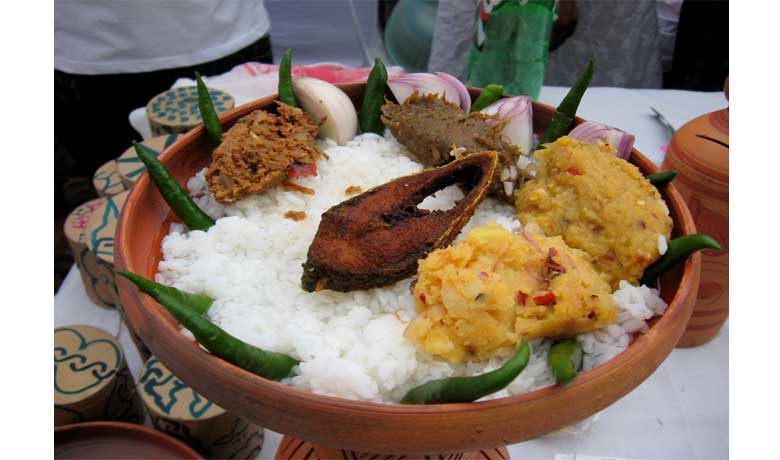
One eats rice with high-rated Hilsa fish on the day while another goes on hungry or eats something normal foods like other days; this is not the teaching of the day.
So, to build up a country without making difference between man and man, we should come forward and we have to build consciousness among the countrymen.
When we will be able to ensure Hilsa for everyone, we will make the country without distinctions.
Let`s try.
risingbd/ DHAKA/ Apr 14, 2015/ Mahfuz/ Augustin Sujan
risingbd.com