Bengali Sonnet Star: Michael Madhusudan Dutt
Augustin Sujan || risingbd.com
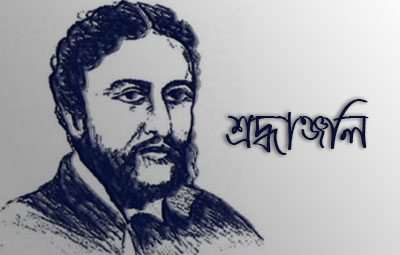
Michael Madhusudan Dutt
Debasish Das from UK: Michael Madhusudan Dutt (1824-1873), the 19th century Bengali poet and playwright, was born on 25 January 1824 in a landed family in the village of Sagardari in Jessore district in Bangladesh.
He was the only son of a well-to-do Kayastha Family. His father, Rajnarayan Dutta, was a law practitioner in Kolkata. Madhusudan in his early years was taught at home by his mother, Jahnabi Devi, and later he joined Sagardari Primary School. At the age of 7 he went to Khidirpur School, Kolkata. In 1843 he got admitted to Kolkata’s famous Hindu College. Here, amongst other subjects, he also studied Bengali, Sanskrit and Persian.
Michael’s exceptionally colorful personality and his unconventional, dramatic and in many ways tragic life have added to the magnetism and glamour of his name. Generous in friendship, romantic and passionate by temperament, he was also fond of the good life; he was financially irresponsible, and an incorrigible spendthrift. He experimented not only in the field of writing, but also in his personal life.
Michael Madhusudan Dutta, who introduced the `blank verse`- a unique form of sonnet but without fixed rhyme, to Bengali poetry.
The poet embraced the Christian faith in 1843 and left college in 1848 on a sojourn to Madras, now Chennai, where he joined Madras University as a junior teacher. Dutta married Rebecca in 1848. Subsequently, he fell for Henrietta, who stuck to him until his end.
The poet eventually returned to Kolkata and started writing in Bangla exclusively, turning out a number of plays and his masterpiece creation of epic dimensions-Meghnadbadh Kabbyo.
At glance Michael Madhusudan Dutt’s Life circle :
• Born: January 25, 1824, Jessore District, Bangladesh
• Died: June 29, 1873, Kolkata, India
• Education: Presidency College, Kolkata
• Books: The slaying of Meghanada, The heart of a rebel poet, Madhusūdana racanābalī
In His Own Words
“Where man in all his truest glory lives,
And nature`s face is exquisitely sweet;
For those fair climes I heave impatient sigh,
There let me live and there let me die.”
Madhusudan embraced Christianity at the church of Fort William in spite of the objections of his parents and relatives on February 9, 1843. Later, he escaped to Madras to escape persecution. He describes the day as:
“Long sunk in superstition`s night,
By Sin and Satan driven,
I saw not, cared not for the light
That leads the blind to Heaven.
But now, at length thy grace, O Lord!
Birds all around me shine;
I drink thy sweet, thy precious word,
I kneel before thy shrine!”
On the eve of his departure to England:
“Forget me not, O Mother,
Should I fail to return
To thy hallowed bosom.
Make not the lotus of thy memory
Void of its nectar Madhu.”
ATTRACTION
He was born in Sagordari in 1824. Sagordari village under Keshavpur Upazila in Jessore district. Sagordari is famous for the residence of Great poet Michael Modhusudon Datta, famous for his wonderful composition of sonnets. This two-storied residence, which is known as Michel Modhusudon museum, is now under the custody of Bangladesh Archeological Department, where you can see the daily usage materials of the great poet. Every year from 25-30 January a great mela (exhibition) is organized here, which is called Modhumela
In memory of the poet written in sagordari
HERE ON JANUARY 25 TH 1824 WAS BORN
MICHEL MADHUSUDHAN DUTT
POET AND SCHOLAR,
DATE 27TH JUNE SUNDAY, 1873
On 27th June 1873, three days after the death of Henrietta, the greatest poet of the Bengal renaissance died in Calcutta General Hospital in a miserable condition at the age of only 49 years. Thus, he and his partner both died prematurely, within 3 days of each other’s demise, leaving behind orphaned children.
Madhusudan`s life was a stupendous boon and also an enormous sorrow. Loss of self-control was mainly responsible for his life’s financial and emotional sorrows and yet it was a God-gifted boon for his over-flowing poetic originality.
The all-inviting epitaph on his grave came from the poet himself:
Stop a while, traveler!
Should Mother Bengal claim thee for her son.
As a child takes repose on his mother`s elysian lap,
Even so here in the Long Home,
On the bosom of the earth,
Enjoys the sweet eternal sleep
Poet Madhusudan of the Duttas.
HOW TO GO THERE
Between sagordari and Keshovpur upazilla headquarter distance is 11 kilo-miters but Sagodari is 40 kilo-miters away from Jessore District. Means of communication is bus, car jeep, van and richsaw.
Debasish Das, MA, MBA (UK): Author – “Bangladesh –E-Parjatan Akarshan” freelance writer, worked in a Renown University in UK at present Working Crime Prevention Unit in Public Sector in UK
risingbd.com